
Installation in Capella de Cardedeu, 1997, Espai Sant Corneli Art.
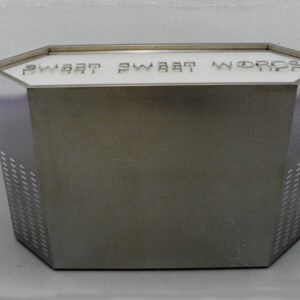
Our Jewish and Christian tradition has supplied western visual culture with a thematic base which has functioned as both narrative material and a motivation for creative work through the centuries. How can anyone be an heir to this tradition and, at the same time, declare himself not to be a religious man? This is the case of Robert Meyer. We will not find the answer, of course, using Faith as a point of reference. But that does not mean that his art is exclusively secular. Going beyond this starting point, he uses the myths, themes and programmes of sacred art in order to question ecclesiastical institutions in themselves. His aim is to allow the church to speak for itself, with the role of the artist being limited, in this case, more to that of a selector than of an interpreter; he wishes to encourage questions before responding to them. A walk through his exhibition in the Capella de Sant Comeli begins, as do all his installations, with a reference taken from the Press. A brief clipping which is barely intelligible, indicative of a position based on reason and not on devotion or obedience to religious hierarchies. It explains the decision of the Bishopric of Barcelona to cancel 149 requests for marriage, of the 157, for religious weakness or incapacity at the moment of union. Absence Signifies Desire is the next work on the itinerary. This is a completely blank book suggesting that absence refers to prohibition, which in its turn provokes desire. The prohibition of sex transfigured the sense of physical contact, which, due to its illicit nature, became radiant with a religious light when practiced. The installation, located in an ancient sacred building, uses the features of the latter. For example, the grating of a choirstall – which looks as if it could have been sitting there for ever and a day and which reminds us of the distance which we necessarily keep when venerating that which is heavenly – keeps the altar reserved for two objects. On the one hand, we find a stoup for holy water which has a dadaist air about it. A female portrait is also hanging from the ceiling, making us doubt which of the roles traditionally assigned to women is in play here. Is it the Virgin Mary or Mary Magadalene? I Have So Many Feelings, written on the wall, leads us to the last piece: a human – even a sinful – Jesus, appears here, reclaiming his natural state. Robert Meyer’s proposal for the Capella de Sant Corneli is conceptually parallel to his I Confess Because I Confess installation which he presented in the Capella de Sant Roc, a religious building which ceased to be used for religious purposes centuries ago, but which has been unable to shake off either its name or its divine atmosphere. Robert Meyer’s creations have Church and religion as their subjects, and seek to set out the contradictions and the importance of religious education. But his contribution is not limited to unquestionable dogmas and doctrines, which are, simply, the starting point for his reflections.
Ferran Barenblit
Reviews
There are no reviews yet.