
ART AGAINST INDIFFERENCEAs well as being aesthetic representation, the visual arts take on a life and identity of theirown at the confluence of the senses. We need only think of the role of art from a historicalperspective, where Velazquez's critical viewpoint stands out, speaking to us through his pain-tings of truth and lies, beauty and ugliness in the Spanish court and history of the seventeenthcentury. In the same way, Goya did not consider hiding the terror of war or the hellish horrorhe experienced in his Black paintings, and nor did Francis Bacon by his paintings of distor-tioned figures. The function of art and the artist can vary according to the impact of eventsand situations in different eras. From an illustrative and decorative dimension to incisions thatare critical, abstract and have a distancing effect on artistic language, art emerges from theshadow of its solitary, obscurantist or narcissistic motivations when it takes on the active roleof a conscious communicator or observer.In his exhibition Guilty, Not Guilty Robert Meyer directly transmits the parti pris of the artist,his art and finally its viewer. The exhibition itself is an instrument for adopting an attitude toconcepts as basic as innocence and guilt in politics and religion. The entrance to the exhibi-tion is located between the fork connected by an electronic counter - one side says "guilty",the other "not guilty". The numbers rise and fall according to those entering or leaving by thisdouble entrance/exit. This theme of arbitrariness is continued throughout the rest of the exhibitionOnce inside the first room of the exhibition, the eye comes to a halt, like moving imagesdid at the moment of becoming a still. A critical and analytical perception reinforces the selec-tive reading of the images which speak to us from Internet and television screens, loaded withpolitical significance, and social and psychological narratives. Observation brings with it thepleasant and disconcerting surprise of the recognition effect. Although the presentation of thethematic image has been transformed by spontaneous manipulation, it is possible to identifythe image which is familiar to us - The President Innocent X portrait, The Last Supper or theface of the child tempt by The Goldfish Money. The exhibition is a linking together of causesof good and evil. The diamand - shaped rustproof sculpture filled with milk in which the wordsSweet Sweet Words are frozen, emphasises their ambiguity. The committed or alienated pers-pective, the interpretative or imaginative description like the transitory material that is the milk on which we feed.The works lead us to the theme found in the central axis, where the show's mental journeyis articulated, which is the approach to some opposing concepts such as forgetfulness andmemory, truth and lies, common good and badness, innocence and guilt, expressed in spiri-tual and material values. T.V. Eye shows us images of people fleeing from the war in formarYugoslavia, the everyday horror that television reminds us and the same television that makesus forget. The stills of mixed photographic images of opera, bear witness to the same momentsof opportunity that we have in front of us, with obligatory interruption, reserving a space inorder to be able to choose, always from the same possibilities, a positive or negative gestu-re according to a conscious decision and where one stands to tell the story and justify it.This invitation to explain oneself materialises in the second room, a confined space. In themiddle one can sit on one of two shiny red benches of the Confessional. The bars of the cellseem like those, of chapel or a prison, in the same way as the physical appearnce of the chairevokes death row. The dramatic images on display in this area belong to the stories sugges-ted by Robert Meyer, which can be seen and told again and again - Nothing, I've heardnothing, Static drama in a frame and The Silent Moment, where the irony of coincidence isthe truth between fiction and reality. Annemieke van de Pas
Exhibition: Guilty not Guilty, Gallery Maria Chailloux, Amsterdam 2001
ART AGAINST INDIFFERENCE As well as being aesthetic representation, the visual arts take on a life and identity of their own at the confluence of the senses. We need only think of the role of art from a historical perspective, where Velazquez's critical viewpoint stands out, speaking to us through his paintings of truth and lies, beauty and ugliness in the Spanish court and history of the seventeenth century. In the same way, Goya did not consider hiding the terror of war or the hellish horror he experienced in his Black paintings, and nor did Francis Bacon by his paintings of distor-tioned figures. The function of art and the artist can vary according to the impact of events and situations in different eras. From an illustrative and decorative dimension to incisions that are critical, abstract and have a distancing effect on artistic language, art emerges from the shadow of its solitary, obscurantist or narcissistic motivations when it takes on the active role of a conscious communicator or observer.In his exhibition Guilty, Not Guilty Robert Meyer directly transmits the parti pris of the artist, his art and finally its viewer. The exhibition itself is an instrument for adopting an attitude to concepts as basic as innocence and guilt in politics and religion. The entrance to the exhibition is located between the fork connected by an electronic counter - one side says "guilty",the other "not guilty". The numbers rise and fall according to those entering or leaving by this double entrance/exit. This theme of arbitrariness is continued throughout the rest of the exhibition. Once inside the first room of the exhibition, the eye comes to a halt, like moving images did at the moment of becoming a still. A critical and analytical perception reinforces the selective reading of the images which speak to us from Internet and television screens, loaded with political significance, and social and psychological narratives. Observation brings with it the pleasant and disconcerting surprise of the recognition effect. Although the presentation of the thematic image has been transformed by spontaneous manipulation, it is possible to identify the image which is familiar to us - The President Innocent X portrait, The Last Supper or the face of the child tempt by The Goldfish Money. The exhibition is a linking together of causes of good and evil. The diamand - shaped rustproof sculpture filled with milk in which the words Sweet Sweet Words are frozen, emphasises their ambiguity. The committed or alienated pers-pective, the interpretative or imaginative description like the transitory material that is the milk on which we feed.The works lead us to the theme found in the central axis, where the show's mental journey is articulated, which is the approach to some opposing concepts such as forgetfulness and memory, truth and lies, common good and badness, innocence and guilt, expressed in spiritual and material values. T.V. Eye shows us images of people fleeing from the war in formar Yugoslavia, the everyday horror that television reminds us and the same television that makes us forget. The stills of mixed photographic images of opera, bear witness to the same moments of opportunity that we have in front of us, with obligatory interruption, reserving a space in order to be able to choose, always from the same possibilities, a positive or negative gesture according to a conscious decision and where one stands to tell the story and justify it.This invitation to explain oneself materialises in the second room, a confined space. In the middle one can sit on one of two shiny red benches of the Confessional. The bars of the cell seem like those, of chapel or a prison, in the same way as the physical appearnce of the chaire vokes death row. The dramatic images on display in this area belong to the stories suggested by Robert Meyer, which can be seen and told again and again - Nothing, I've heard nothing, Static drama in a frame and The Silent Moment, where the irony of coincidence is the truth between fiction and reality. Annemieke van de Pas
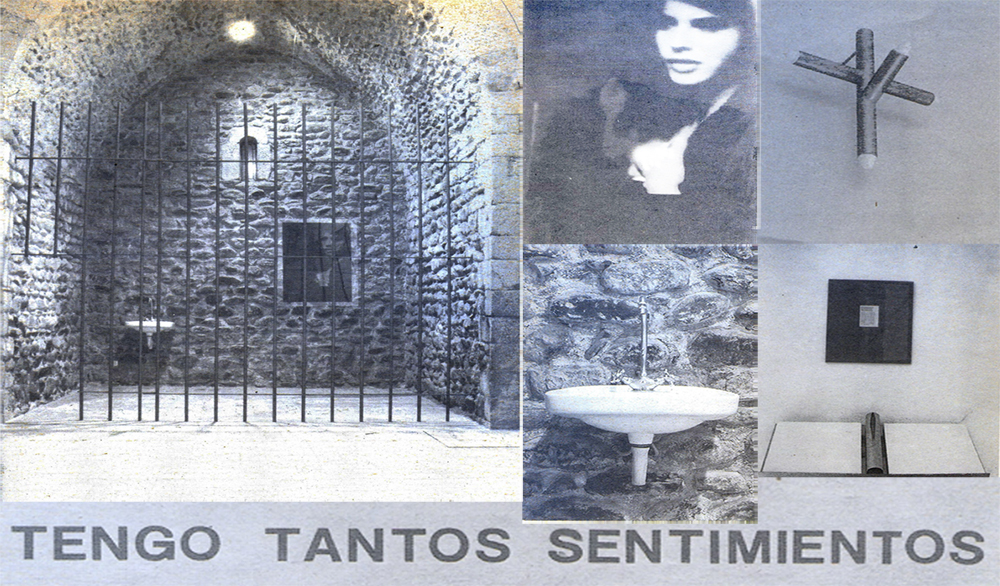
Exhibition: I am not a religious man, Chapel Cardedeu, Spain, 1997
Our Jewish and Christian tradition has supplied western visual culture with a thematicbase which has functioned as both narrative material and a motivation for creative work through the centuries. How can anyone be an heir to this tradition and, at the same time, declare himself notto be a religious man? This is the case of Robert Meyer. We will not find the answer, ofcourse, using Faith as a point of reference.But that does not mean that his art is exclusively secular. Going beyond this starting point, he uses the myths, themes and programmes of sacred art in order to question ecclesiastical institutions in themselves. His aim is to allow the church to speak for itself, with the role of the artist being limited, in this case, more to that of a selector than of an interpreter; he wishes to encourage questions before responding to them. A walk through his exhibition in the Capella de Sant Comeli begins, as do all his installations, with a reference taken from the Press. A brief clipping which is barely intelligible, indicative of a position based on reason and not on devotion or obedience to religious hierarchies. It explains the decision of the Bishopric of Barcelona to cancel 149 requests for marriage, of the 157, for religious weakness or incapacity at the moment of union. Absence Signifies Desire is the next work on the itinerary. This is a completely blank book suggesting that absence refers to prohibition, which in its turn provokes desire. The prohibition of sex transfigured the sense of physical contact, which, due to its illicit nature, became radiant with a religious light when practiced. The installation, located in an ancient sacred building, uses the features of the latter. For example, the grating of a choirstall - which looks as if it could have been sitting there for ever and a day and which reminds us of the distance which we necessarily keep when venerating that which is heavenly - keeps the altar reserved for two objects. On the one hand, we find a stoup for holy water which has a dadaist air about it. A femaleportrait is also hanging from the ceiling, making us doubt which of the roles traditionally assigned to women is in play here. Is it the Virgin Mary or Mary Magadalene? I Have So Many Feelings, written on the wall, leads us to the last piece: a human – even a sinful - Jesus, appears here, reclaiming his natural state. Robert Meyer's proposal for the Capella de Sant Corneli is conceptually parallel to hisI Confess Because I Confess installation which he presented in the Capella de Sant Roc,a religious building which ceased to be used for religious purposes centuries ago, butwhich has been unable to shake off either its name or its divine atmosphere.Robert Meyer's creations have Church and religion as their subjects, and seek to set out the contradictions and the importance of religious education. But his contribution is not limited to unquestionable dogmas and doctrines, which are, simply,the starting point for his reflections. Ferran Barenblit